

Colorado Trail Weather by Month: When is the Best Time to Hike?
As you start planning your Colorado Trail backpacking trip, one of the questions you will eventually run up on is:
“When is the best time of year to backpack the Colorado Trail?”
At first, I assumed the answer would be simple. Summer equals hiking season, right? But the more I researched the Colorado Trail, the more I realized that timing can have a huge impact on your experience. A trip in June can be completely different from a trip in September. Some sections are still dealing with snow while others are already seeing afternoon thunderstorms. A month that is perfect for one part of the trail might not be the best choice for another. For thru-hikers that are going to be out there for 30+ days on a trail that’s only open for about 4 months, they kind of just have to suck it up and deal with it.
But for section hikers, we have options. Instead of trying to force every trip into the same part of the year, we can choose sections that match the conditions we’re most comfortable with. That’s one of the advantages of hiking the Colorado Trail over multiple trips instead of trying to complete it all at once.

As I have been building out my Colorado Trail Section Hike Plan, here are some of the things I’ve learned about Colorado Trail weather from June through October, and how I’m using that information when planning section hikes.
June: Earlier Than Most People Think
When most people think about Colorado backpacking season, they tend to picture July and August. But June can actually be a great month for certain sections of the Colorado Trail. Lower elevation stretches closer to Denver are usually in decent shape by June. Temperatures are comfortable, the days are long, and afternoon thunderstorms usually aren’t as common as they will be later in the summer.
The challenge is snow, and the catch is that not all sections melt out at the same time. While some sections may be ready for hiking, higher elevations can still be holding onto winter. Depending on the snowpack, sections of the Collegiate Peaks, and especially the San Juans, may still have lingering snowfields or difficult conditions.
Another factor to consider is runoff from melting snow. Even if the trail itself is mostly clear, creek crossings can be higher and faster than they will be later in the season.
If I were planning a June trip, I’d probably focus on the northern sections of the trail and save the highest terrain for later in the year.
July: Peak Hiking Season
By July, the Colorado Trail is finally starting to look like the trail most people imagine. Snow has largely melted from the high country, nearly every section is accessible, and the long summer days make it easier to cover miles. If someone asked me to pick one month that works reasonably well for the entire trail, July would probably be my answer.
That doesn’t mean July is perfect, though. One thing that surprised me while researching the Colorado Trail was how just serious the thunderstorms, and especially lightning, can be. Before I started planning, I imagined thunderstorms as an occasional inconvenience. The more I learned, the more I realized they are one of the biggest hazards hikers face on the CT!
Many sections of the Colorado Trail spend significant time above treeline. Once thunderstorms begin building, there aren’t always good places to hide. July is when that risk starts becoming a major factor in trip planning.
The solution isn’t necessarily avoiding July. It’s understanding that an early morning start becomes part of your safety strategy. Many experienced Colorado hikers are on the trail before sunrise and try to be descending from exposed ridges by early afternoon.
August: The Monsoon Month
August may be the most misunderstood month on the Colorado Trail. On paper, it sounds ideal. The snow is gone, temperatures are warm, wildflowers are blooming, and every section is open. The problem is that August often coincides with Colorado’s monsoon season. The phrase “afternoon thunderstorms” does not mean the occasional rain shower. It’s more of a daily pattern. A typical August day might begin with perfectly blue skies. By noon, clouds start building over the peaks. By early afternoon, thunder can be echoing across the mountains. Not every day follows that pattern, but it happens often enough that hikers need to plan around it.
That doesn’t mean August is a bad time to hike. Hundreds of hikers enjoy the Colorado Trail during August every year. It simply means that weather awareness becomes more important. If you’re hiking high, exposed terrain during August, your daily schedule matters almost as much as your gear.
September: The Sweet Spot
The more I’ve researched the Colorado Trail, the more September keeps standing out as the month I’d most like to hike. In fact, I’m currently planning on making Labor Day week my “standard” CT backpacking week for most years.
In September many of the challenges from earlier in the season begin to fade. The snow is long gone. Monsoon activity is usually decreasing. Crowds begin thinning out. The aspens start changing color. Temperatures remain comfortable during the day while nights become cooler and crisper. September often offers some of the most stable weather of the year.
There are tradeoffs, of course. The days are a little shorter, and overnight temperatures can drop significantly, especially at higher elevations. Early season snowstorms become possible as well. But compared to the snow concerns of June or the lightning concerns of August, those risks feel easier to manage, at least to me.
When it comes to choosing a month to tackle some of the Colorado Trail’s highest and most exposed sections, particularly the Collegiate West or the San Juans, September would be my first choice.
October: Beautiful but Unpredictable
October is where things start getting complicated again. On one hand, it might be the most beautiful month on the trail. Fall colors can be spectacular, crowds are minimal, and lightning is rarely a concern.
On the other hand, winter is no longer just a possibility, it’s fast approaching. A section that is dry and pleasant one weekend could receive a significant snowfall the next. Nights become much colder, and shorter daylight hours leave less room for mistakes.
For that reason, I’d generally view October as a bonus month rather than a core hiking month. It’s fantastic for day-hiking, but I don’t think I would want to be out there backpacking for multiple days. If conditions cooperate, great. If they don’t, it’s probably time to start looking ahead to next season.
Which Sections Are Best During Each Month?
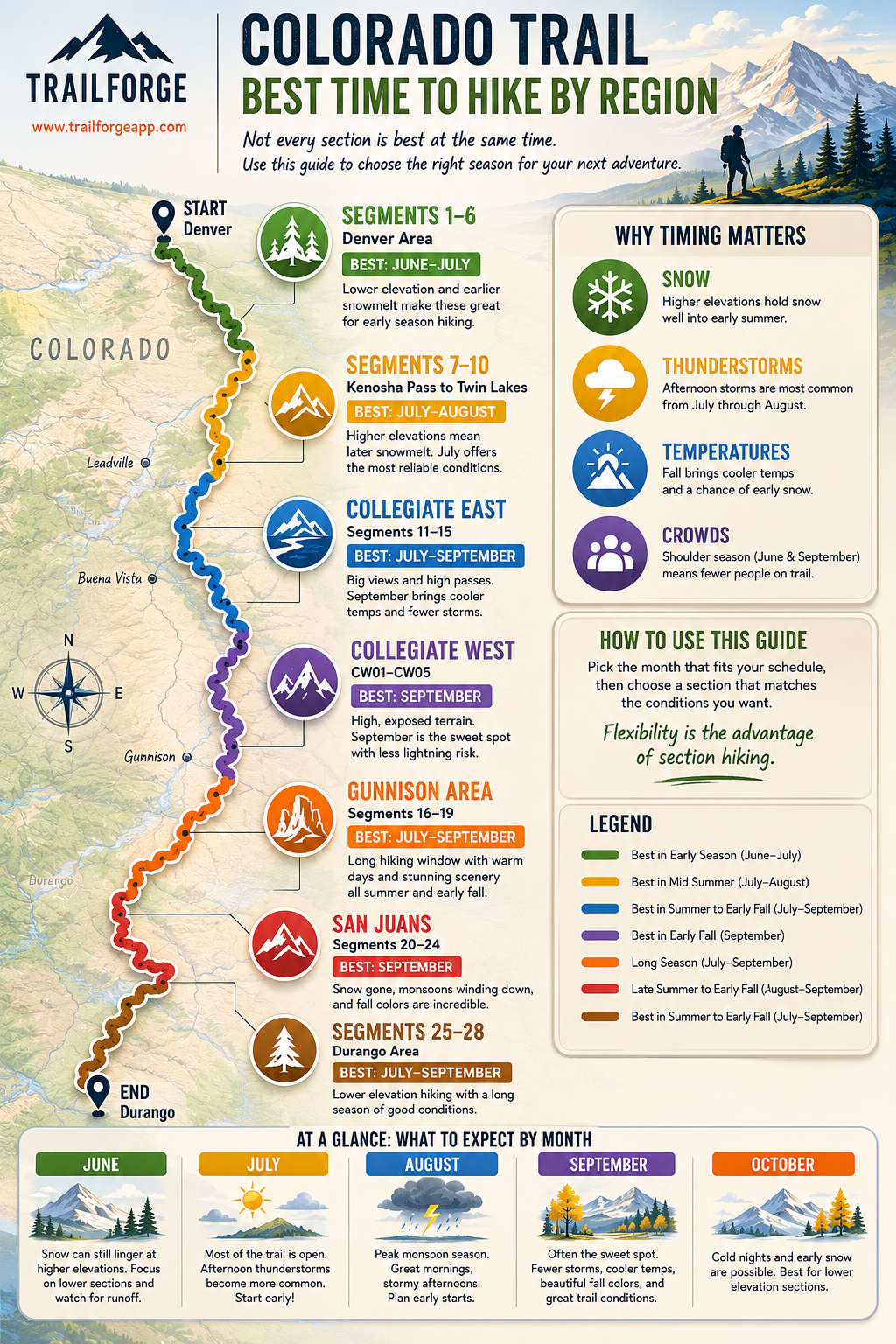
One of the biggest lessons I’ve learned while planning the Colorado Trail is that there really isn’t a single “best” month for the entire trail. Different sections shine at different times. If I were looking at the northern sections closer to Denver, I’d be perfectly comfortable targeting late June or July. For the Collegiate East and Gunnison-area sections, July through September all look like strong options.

The Collegiate West and San Juans are where September starts becoming especially attractive. These routes spend a lot of time high above treeline, and reducing exposure to afternoon lightning is a major advantage. While July and August are certainly popular, September often appears to offer the best combination of snow-free trails, reduced thunderstorm activity, and comfortable hiking temperatures. That’s one reason many Colorado Trail section hikers save the Collegiate West and San Juans for late summer or early fall.
So, When Is the Best Time to Hike the Colorado Trail?
The answer depends on what you’re looking for. If your goal is simply to maximize access to the entire trail, July is hard to beat. If you love wildflowers and don’t mind planning around afternoon storms, August can be fantastic.
The nice thing about section hiking is that you don’t have to choose just one month. You can hike the lower sections in June, explore the central portions during July or August, and save the high alpine sections for September. Instead of trying to force the entire Colorado Trail into a single weather window, you can let the seasons help guide your plan.
But if you’re asking for my personal opinion after spending countless hours researching Colorado Trail conditions, September keeps coming out on top, and that’s when I’ll be doing most of my trips.
Start planning your Colorado Trail adventure today!
Download the free Colorado Trail Section Hiker Planning Guide and learn how to break the trail into manageable sections, avoid common mistakes, and build a realistic multi-year plan.


One Comment
Comments are closed.